
After my wife's emergency C-section, I sat down with the insurance bills and couldn't make sense of them. I have a law degree, an MBA and more than 10 years in patient access. I still couldn't tell what we owed or why.
Those bills came after the care. Prior authorization creates the same confusion before the care. And the patient can't start treatment until someone sorts it out.
On October 29, I'm recording an episode of The Hub Brief with Dr. Archelle Georgiou. She was chief medical officer of UnitedHealthcare from 1995 to 2007. Today she hosts the podcast Speak Up for Your Health. In July, she wrote a line in Managed Healthcare Executive that has stayed with me: "Prior authorization isn't broken. It's unmeasured".[1]
Here's the question I'm taking into that conversation: What would it take for prior authorization to stop costing patients time they never get back?
I don't have the answer yet. So before we talk, I'm writing down 5 bets. Each one ends with a question I'll ask Archelle, and her answer decides whether the bet holds. Some bets are about drugs and some are about medical services, because the rules treat them differently. After the episode, I'll publish a scorecard that marks each bet as held, moved or broke.
Bet 1 — Decision deadlines won't shorten the patient's wait
Drug prior authorization already has deadlines, and some are old. Since 1991, state Medicaid programs have had to answer a drug request within 24 hours.[2] Medicare Part D plans have to answer within 72 hours, or 24 hours if the request is urgent.[3]
Patients still wait. IQVIA studied new branded drugs in Part D. In cases where a plan first denied a patient's new drug and later approved it, the approval took about 11 days on average.[4]
The deadline can't prevent that wait, because it covers only one decision. Here's how the days add up in Part D. Take an exception request, which asks the plan to cover a drug that's off its list or to waive one of its limits. The 72-hour clock doesn't start until the doctor's supporting statement arrives. If the plan denies the request, the appeal runs on a separate clock. Every step can meet its own deadline, and the patient still waits through all of them. No CMS report adds those steps together.
In April, CMS proposed a new rule for drugs, called CMS-0062-P.[5] It would set new deadlines for Medicaid, the Children's Health Insurance Program (CHIP) and marketplace plans. From 2028, it would also publish how long plans take from request to decision. That's progress. But it measures only the plan's part of a wait that runs from prescription to first dose.
What I'll ask Archelle: Plans can meet every deadline while a patient waits 11 days. Should the rules measure the patient's full wait, from prescription to first dose? Or would that make plans answer for steps they don't control?
Bet 2 — The Friction Index ranks the plans, but it can't see the wait for drugs
Archelle didn't stop at saying prior authorization is unmeasured. She built a way to measure it, called the Friction Index. It combines 4 numbers. Under a 2024 CMS rule, plans have had to publish them since 2026:
- how many prior authorizations a plan requires
- how often it approves them
- how often it denies them
- how often its denials are overturned on appeal
The rule covers Medicare Advantage, Medicaid and marketplace plans.[6] Archelle has scored 155 Medicare Advantage contracts, each with more than 5,000 members.[1]
Before 2026, plans didn't have to publish these numbers in a common format. Now they do, so anyone can compare plans side by side.
But the 2024 rule covers only medical items and services. Drugs fall outside it. So the index can't see the wait that patient access programs exist to shorten. That wait runs from the day a doctor prescribes a specialty drug to the day the patient takes the first dose. Under the April proposal, public drug data starts in 2028 at the earliest.[5] Even then, it will measure only the time from request to decision. The days before the request and after the decision still won't show up in any public number.
What I'll ask Archelle: Your index covers medical services, because that's the data the 2024 rule made public. What would you add to it for drugs, and who would have to report it?
Bet 3 — Automating the payer's side will speed up the decision and move the wait to the doctor's office
Plans control half of the prior authorization process, and they've promised to automate their half. In a June 2025 pledge, insurers set a goal for 2027. By then, at least 80% of electronic prior authorization approvals should come back in real time.[7]
The doctor's office controls the other half, and its workload is still heavy. The AMA's 2025 survey found that each physician handles about 40 prior authorizations a week. Those requests take 13 hours of physician and staff time every week.[8]
A real-time approval helps the patient. A real-time denial helps far less. The denied request still goes back to a doctor's office, where someone has to pull the chart, find what's missing and send the request again. The patient waits on the slowest step, and automating the plan's side doesn't speed up that step. I call this digitized friction: the old process, running at machine speed on only one side.
I'd most like Archelle to prove me wrong on this one, because she has made these decisions from the payer's side.
What I'll ask Archelle: When you were a plan's chief medical officer, what would a doctor's office have needed to send for you to approve a request the moment it arrived?
Bet 4 — Prior authorization should stay, but most of it doesn't save what it's supposed to save
This bet may surprise people who expect a payers-versus-patients show. I don't want to get rid of prior authorization. Neither does Archelle. In her words: "Prior authorization needs to be optimized, not eliminated."[1]
Plans defend prior authorization as a way to control costs. The 2024 Medicare Advantage data makes that harder to argue. That year, plans made nearly 53 million prior authorization decisions across all services. They approved about 92% of them.[9] So for most patients, the review ended in a yes. All it added was the time spent waiting for that yes. Plans denied the rest, and only 11.5% of those denials were appealed. Of those appeals, 80.7% were overturned in full or in part.
Archelle's own research changed how I think about this. She compared each plan's Friction Index score with its medical-loss ratio, which is the share of premium a plan spends on care. She found virtually no correlation. In her words, "plans with the most burdensome prior authorization programs are not spending meaningfully less on care".[1]
If she's right, the extra burden isn't buying extra savings. A smaller program could keep prior authorization only where review changes the decision. That smaller program could still protect most of the savings prior authorization protects today.
What I'll ask Archelle: If plans could keep prior authorization on only a small share of what they review today, which requests would you keep, and why?
Bet 5 — Patients need insight first, and insight costs the least to give
In patient access, I see patients run short on 4 things:
- time
- authority over their own records
- control over what happens next
- insight into where things stand
I call this TACI. It's the lens I use for patient friction.
My bet is that insight matters first. Patients who know where their request is, who has it and why it was denied can act. Patients who don't can only call and wait. Insight is also the cheapest of the 4 to provide. The plan already knows the status of every request. It just has to show the patient what it knows, which makes this a reporting job.
I felt this with our C-section bills. All I needed was to know what each charge was for.
For medical services, the rules are moving this way. Since January 2026, plans under the 2024 CMS rule have had to give a specific reason when they deny a medical item or service. By January 2027, they'll also have to show prior authorization status in the Patient Access API, the system patients use to see their health records.[6] Neither requirement covers drugs yet. The April proposal would add both.[5]
What I'll ask Archelle: You've spent years helping patients speak up for their own care. What do they ask for first: a lower bill, or knowing where their request stands?
The scorecard, before the conversation
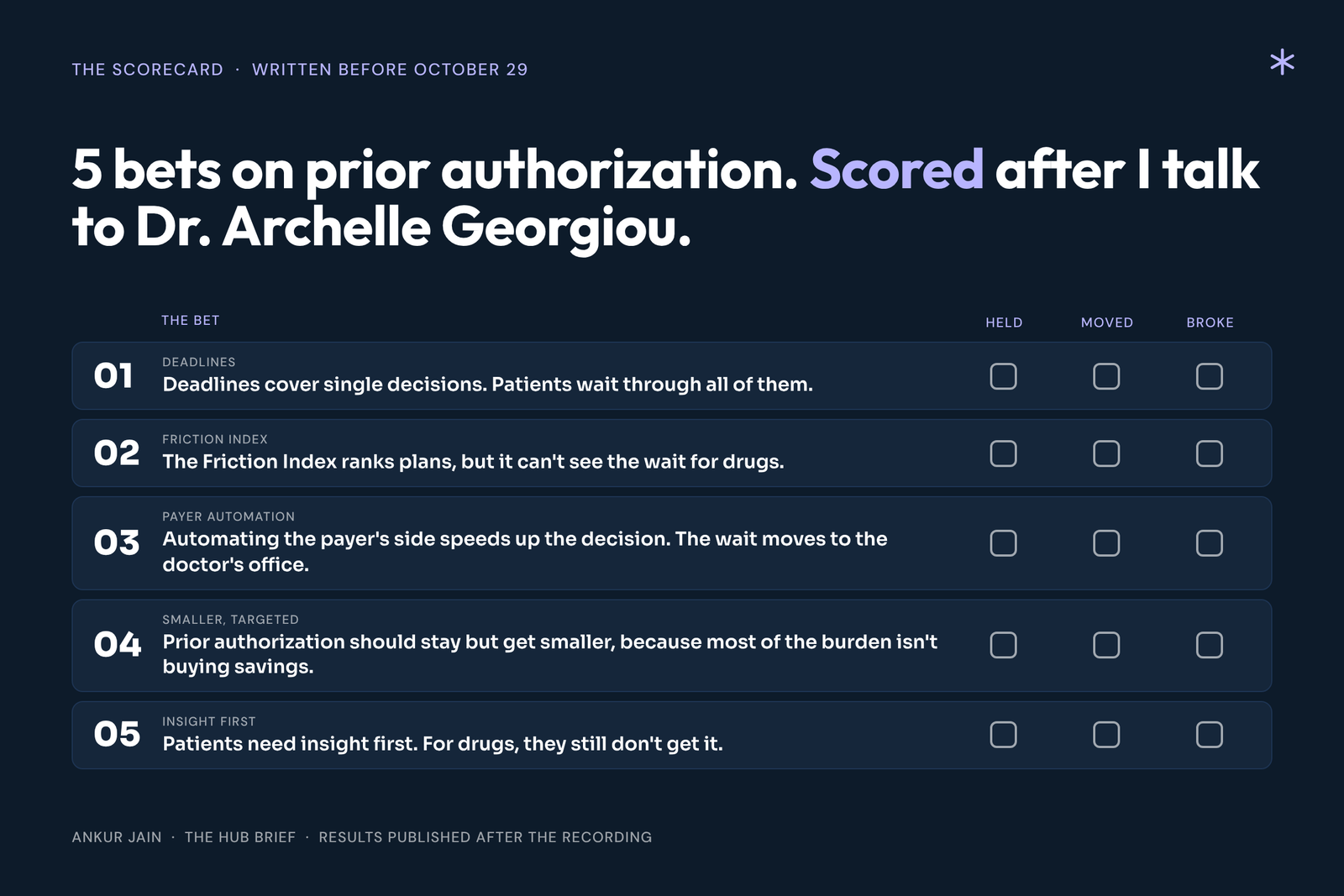
Here's what I'm walking in with.
Bet 1: Deadlines cover single decisions. Patients wait through all of them.
Bet 2: The Friction Index ranks plans, but it can't see the wait for drugs.
Bet 3: Automating the payer's side speeds up the decision. The wait moves to the doctor's office.
Bet 4: Prior authorization should stay but get smaller, because most of the burden isn't buying savings.
Bet 5: Patients need insight first. For drugs, they still don't get it.
I'll publish the scorecard after we talk, including the bets I lose.
I knew which questions to ask about our C-section bills, and I still couldn't get answers. Many families don't even know which questions to ask. That gap is what this conversation is about.
Which of these 5 bets would you bet against? Tell me in the comments. I'll put the strongest challenge to Archelle on October 29.
Ankur Jain, J.D., MBA — Artha Consulting Lab · ankur.jain@arthaconsultinglab.com
The Hub Brief · Pre-episode with Dr. Archelle Georgiou
Next: The Scorecard — what held, what moved and what broke after my conversation with Dr. Archelle Georgiou
Sources
[1] Archelle Georgiou, M.D., "Prior authorization isn't broken, it's unmeasured," Managed Healthcare Executive, July 1, 2026. managedhealthcareexecutive.com
[2] Social Security Act §1927(d)(5): Medicaid drug prior authorization programs must respond within 24 hours of a request. Applies to drugs dispensed on or after July 1, 1991.
[3] 42 CFR 423.568(b) and 423.572(a): Part D coverage determinations within 72 hours standard, 24 hours expedited; for exception requests the clock starts when the prescriber's supporting statement is received.
[4] IQVIA, Ehrenberg and Courneau, analysis of first fill attempts for new branded medicines in Medicare Part D, March 18, 2026. iqvia.com
[5] CMS-0062-P, Interoperability Standards and Prior Authorization for Drugs, proposed rule. Announced April 10, 2026; comment period closed June 15, 2026; not final as of this writing. Proposed compliance dates October 1, 2027; drug metrics reported from 2028. cms.gov
[6] CMS-0057-F, Interoperability and Prior Authorization Final Rule, January 2024. Denial reasons and decision deadlines from January 1, 2026; public prior authorization metrics first posted by March 31, 2026; Prior Authorization and Patient Access API requirements from January 1, 2027. Applies to items and services, not drugs. cms.gov
[7] AHIP-led health plan commitments on prior authorization, announced with HHS in June 2025; reported by MedCity News. medcitynews.com
[8] American Medical Association, 2025 Prior Authorization Physician Survey (1,000 physicians), press release May 13, 2026. ama-assn.org
[9] KFF, Medicare Advantage prior authorization requests, denials and appeals in 2024 (all services), January 28, 2026. kff.org